Trade Integration Beyond Borders: What AfCFTA Means for West African SMEs

A cross-border customer once arrived at a wholesale pharmacy in Northern Nigeria with no documentation, no formal purchase order, and no bank transfer. He had cash. He had a clear list of what he needed. And he had done this journey before, from Niger, several times.
That was the trade system. Cash, memory, and a trusted face. Not because he was unsophisticated. Because the formal system offered him nothing better.
I watched this pattern repeat, with customers from Benin and Niger. Deliveries would arrive late and pricing would shift without warning. Language created friction at almost every stage. The cost of moving goods across the border was embedded in every transaction, whether or not it appeared on any invoice.
AfCFTA is supposed to change that. This brief explains why it will struggle to do so, and what it would actually take to reach the traders I have seen
.
The Agreement and What It Promises
AfCFTA covers over 1.4 billion people and a combined GDP exceeding $3 trillion. The stated goal is a continental single market: reduced tariffs, harmonised regulations, and a structure for intra-African trade to grow at scale.
The projections are significant. Full implementation by 2045 is estimated to add $141 billion to Africa’s GDP and increase intra-African trade by up to 45 percent. Intra-African trade reached $192.2 billion in 2023, with its formal share rising from 13.6 to 14.9 percent.
These are real numbers. The momentum is real. But the question is not whether AfCFTA is ambitious. It is whether the agreement is designed in a way that reaches the trader in Kebbi, the distributor in Kano, the pharmacy buyer crossing from Niamey.
On that question, the current picture is harder to read.
11.5%
Intra-ECOWAS trade as a share of total trade — in a sub-region f over 350 million people
The SME Problem Is Structural, Not Incidental
SMEs make up over 90 percent of enterprises across Africa. They account for roughly 80 percent of employment. Any trade agreement that does not work for them does not work for the continent.
The obstacles are not new. A trade finance gap estimated at $100 billion limits the working capital most SMEs need to operate across borders. Non-tariff barriers, complex regulatory requirements, and product certification costs price out traders who cannot afford compliance teams or legal advisors.
The deeper problem is simpler than any of that. When the formal system offers no clear advantage over the informal one, traders stay informal.
Customers operated on cash and trust networks because that system was faster, cheaper, and more reliable than anything the formal trade corridor offered them. That is not a cultural preference. That is a rational response to a system that was not built for them.
When formal channels are inaccessible, unreliable, or more expensive than informal ones, rational economic actors choose informality. AfCFTA cannot change that by decree.
The agreement lowers tariffs. It harmonises rules on paper. But it does not automatically lower the cost of crossing a border, shorten a delivery cycle, or give a small trader access to affordable finance. Those gaps are where AfCFTA will either succeed or stall.
The Infrastructure Gap Will Arrive Before the Policy Does
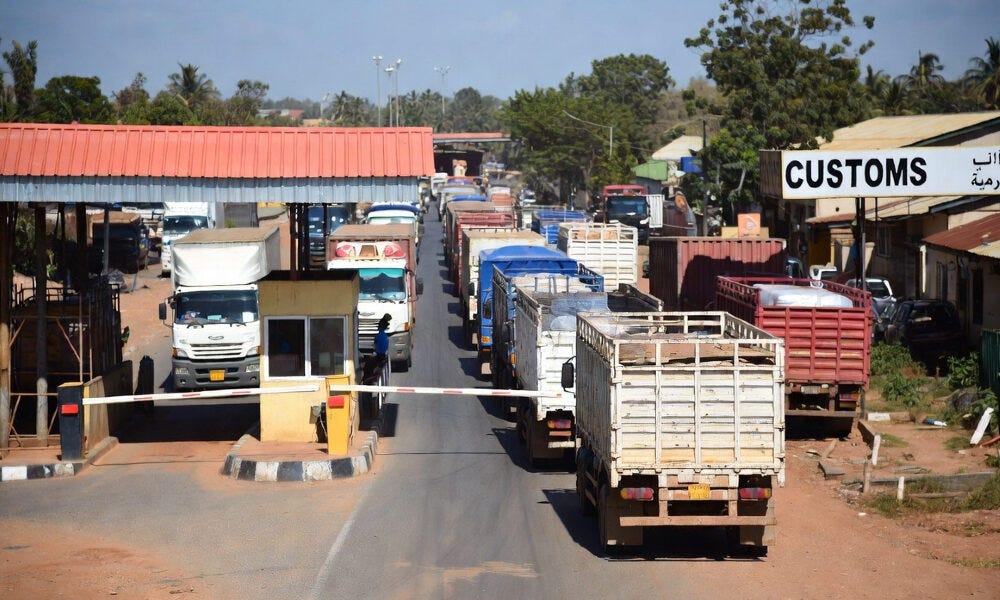
Trucks along the Abidjan-Lagos corridor spend up to 52 hours at major border crossings. End-to-end journeys stretch to ten days. Every hour of delay is a cost that lands somewhere in the supply chain, usually at the bottom.
I saw this from the receiving end. A delayed shipment does not just arrive late. It shifts the price. It forces a renegotiation or a substitution. It erodes the trust between buyer and supplier that informal trade depends on. Over time, it pushes more of the transaction off the record and out of any formal system.
The currency architecture compounds the problem. A northern Nigerian trader buying from a Nigerien supplier needs naira converted to CFA francs. The formal channels for that transaction remain constrained. The settlement moves informal by default, not by preference.
The institutions are not blind to this. The Abidjan-Lagos corridor highway, a $15.6 billion project spanning five countries, is scheduled to begin construction in 2026 and is projected to reduce transit times by 40 percent. ECOWAS and TradeMark Africa have developed a Standards and Technical Barriers roadmap for 2025 to 2027. These are serious commitments.
The risk is sequencing. Policy moves faster than construction. Formalisation frameworks arrive before the infrastructure that would make formalisation worthwhile. SMEs get asked to participate in a system that is not yet ready for them.
52 hrs
Average border crossing delay on the Abidjan-Lagos corridor. That delay is a tax on every SME that trades across it.
Three Things That Would Actually Change the Outcome
The AfCFTA Secretariat’s SME Financing Facility exists. The ECOWAS-AfDB Institutional Support Project has directed $2.8 million toward private sector engagement in six vulnerable West African countries. These are steps in the right direction.
They will underdeliver if the underlying design does not change. Three shifts matter most.
Trade information has to function as public infrastructure. A pharmaceutical trader in Niger, a distributor in Accra, and a manufacturer in Lagos each face a version of the same problem: they do not know what AfCFTA means for their specific transaction. The Secretariat is building digital infrastructure for trade documentation, payments, and logistics tracking. That work needs to move faster, and it needs to work in French, English, Hausa, and every other language in which West African commerce actually operates.
Language is not a soft issue. It is an operational barrier. When a buyer from Niger walks into a pharmacy in Kebbi, the transaction works because two people found a way to communicate across a language gap. No institution arranged that. Trade facilitation programs that do not account for language are building on a foundation that the market already solved informally.
SME input needs to happen at the design stage, not the consultation stage. The traders who have built functioning cross-border commerce on cash and trust have accumulated knowledge about what actually works. That knowledge should be an input into implementation, not a footnote in a report.
The Standard the Agreement Will Be Judged By
AfCFTA will be judged by whether it makes trade easier, cheaper, and more predictable than the informal systems already in use.
That is a high bar. The informal system is fast. It runs on relationships that took years to build. It requires no documentation. It settles in cash the same day.
The formal system will only displace it when it offers something better. Not just in policy terms. In operational terms.
The traders I saw in Northern Nigeria were not waiting for a continental agreement to make commerce possible. They had already made it possible, on their own terms, across borders that formal systems treated as barriers.
AfCFTA’s real task is not to open trade. It is to make the formal version of trade worth choosing.
That work starts at the ground level. It requires institutions that understand what the ground level actually looks like.
About MSCD Africa
MSCD Africa is a diagnostic platform covering market systems, capital, and development finance in Africa. It publishes briefs, hosts conversations, and engages institutions working at the intersection of policy and economic practice. Follow at substack.com/@silasani or search MSCD Africa on Spotify and Apple Podcasts.